
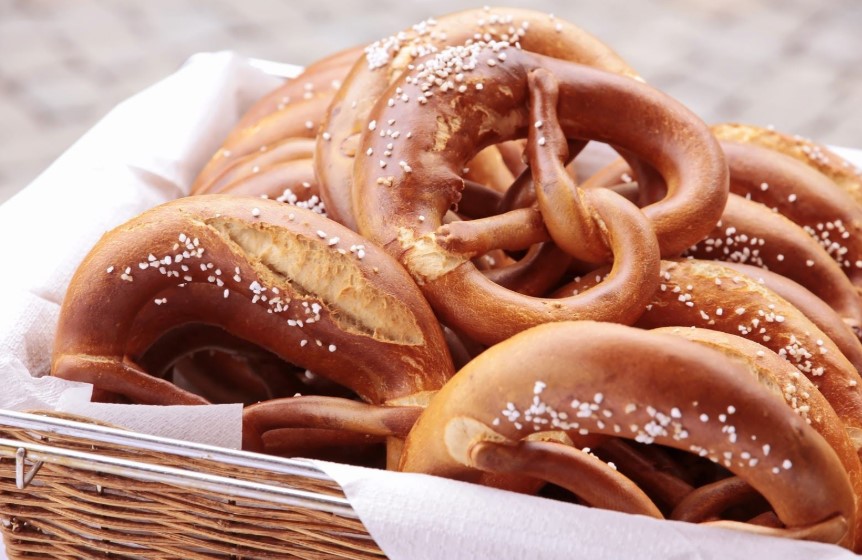
German Pretzels (Brezeln)
Pretzels look like a shaped bread roll, and if you bake them like one that is exactly what you get. What makes a pretzel a pretzel is a step most home recipes leave out: a brief dip in an alkaline solution before baking.
That dip is what produces the dark mahogany crust, the distinctive chew, and the flavor you cannot place but recognize immediately. Skip it and you have a bread knot.
Makes 8
Rising time: about 1 hour
Ingredients
For the dough
4 cups all-purpose flour
1/2 cup milk
3/4 cup warm water, approximately
2 1/4 teaspoons active dry yeast
1 tablespoon butter, softened
1 teaspoon salt
1 teaspoon sugar
For the bath
8 cups water
1/3 cup baking soda
For the top
Coarse salt
1 egg yolk beaten with a splash of water (optional)
Method
Make the dough
Mix the flour and salt in a bowl and make a well in the center.
Dissolve the yeast and sugar in the warm water and leave for 10 minutes, until foaming.
Add the yeast mixture, milk and softened butter to the flour and knead for 10 minutes, until smooth and elastic. Pretzel dough should be firm — stiffer than bread dough — so hold back on the water. Soft dough will not hold the shape.
Cover and let it rise for about an hour, until doubled.
Shape
Divide into 8 pieces.
Roll each piece into a rope about 20 inches long, thicker in the middle and tapering at the ends. Roll from the center outward with both hands.
Form a U, cross the ends over each other twice, then bring them down and press them onto the bottom of the loop.
Lay the shaped pretzels on parchment-lined trays and let them rest, uncovered, for 20 minutes. A slightly dried surface takes the bath better.
The bath
Preheat the oven to 425°F.
Bring the water to a boil in a wide pot and add the baking soda gradually — it will foam up, so add it in stages and stand back.
Use a stainless steel or enamel pot, not aluminum. Alkaline solution reacts with aluminum and will discolor both the pot and the pretzels.
Lower two or three pretzels at a time into the simmering water for 30 seconds, turning once. Lift them out with a slotted spoon and drain briefly.
Thirty seconds, no more. Longer and the dough starts cooking through and the surface goes slimy.
Return them to the parchment.
Bake
Sprinkle generously with coarse salt while the surface is still wet — that is the only moment it will stick.
Brush with egg yolk if you want extra shine, though the bath alone gives them good color.
Slash the thick part of each pretzel with a sharp knife if you want the traditional split.
Bake for 12 to 15 minutes, until deep brown. Properly baked pretzels are much darker than you would take a bread roll — pull them pale and they taste of nothing.
Eat warm, the same day. Pretzels are at their best within a few hours and they stale fast.
Chef’s notes
Traditional German bakeries use food-grade lye rather than baking soda, which gives a darker crust and a stronger flavor. Lye is caustic and requires gloves and care; baking soda is the safe home version and gets you most of the way there.
You can push baking soda closer to lye by baking it first: spread it on a foil-lined tray and bake at 300°F for an hour. This converts it to sodium carbonate, which is more alkaline. Handle it with gloves afterward.
Serve with mustard, obersalzer or a beer cheese dip. In Bavaria a pretzel comes with sweet mustard and Weisswurst, and it is worth trying that combination once.


Leave a Reply
Want to join the discussion?Feel free to contribute!