
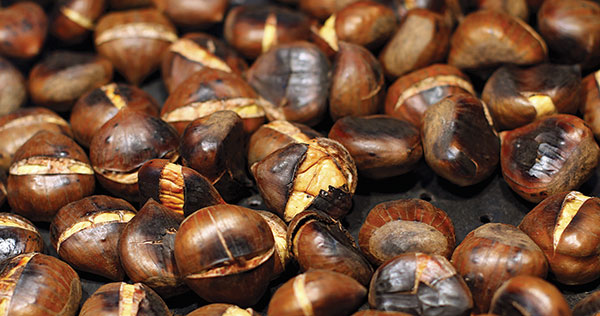
Chestnuts: A Turkish Winter
Before the Renaissance, the chestnut was one of Europe’s staple foods, and it was used in nearly every form imaginable. Roasted over coals or baked, cooked into stews alongside vegetables, ground into flour for bread, biscuits and cakes. Sometimes it became ice cream, sometimes candy, sometimes pastry.
The chestnut tree grows wild across Anatolia and the surrounding region. It spread into Europe during the Roman period, and the nut has been part of the cooking of a dozen countries ever since — but nowhere more thoroughly than in Ottoman and Turkish kitchens. It turns up in pilafs, in braises, in desserts.
Still, for most of us, nothing competes with the chestnuts sold on the street.
Turkish homes rarely have coal stoves anymore, but chestnuts have not lost their place in winter. Toward the end of autumn the vendors appear on street corners across the country, sheet-metal carts with a small charcoal fire burning underneath, and it is as reliable a sign of the season as the weather itself. The nuts take on the smell of the coals they cook over, and a paper cone of them warms your hands as much as anything else.
Where the good ones come from
If you have wondered why street chestnuts taste better than the ones you roast at home, part of the answer is the variety.
The nuts used for roasting are usually kuzu kestane — “lamb chestnut” — which grows in the Black Sea region. Smaller, sweeter, and easier to peel than the larger varieties.
But the Black Sea is not where most Turkish chestnuts come from. Neither is Marmara, despite Bursa’s reputation. The largest producer is the Aegean, and Aydın in particular grows them by the ton — enough to make Turkey the largest chestnut producer in Europe.
Bursa’s reputation goes back much further than its production figures. The Bursa chestnut was known well into antiquity, carried by the Greeks to Greece and from there into Italy and around the Mediterranean. And kestane şekeri — candied chestnut, Bursa’s specialty — has travelled considerably further than that.
How to roast them at home
Score each nut with a deep X through the shell on the flat side. This is not optional: chestnuts build steam inside as they heat and will burst without a vent.
Roast at 425°F for 20 to 25 minutes, or in a heavy pan over high heat, shaking often.
Peel them while they are still hot. Both the shell and the papery inner skin come away easily when warm and become almost impossible once cold. Wrap the roasted nuts in a clean cloth for five minutes first — the trapped steam loosens the skins.


Leave a Reply
Want to join the discussion?Feel free to contribute!